WARP-VLA: Wrist-Camera Adaptation for View-Robust Policy Execution in Vision-Language-Action Models
 1Yonsei University
 2Korea Electronics Technology Institute (KETI)
*Equal contribution †Corresponding author
Abstract
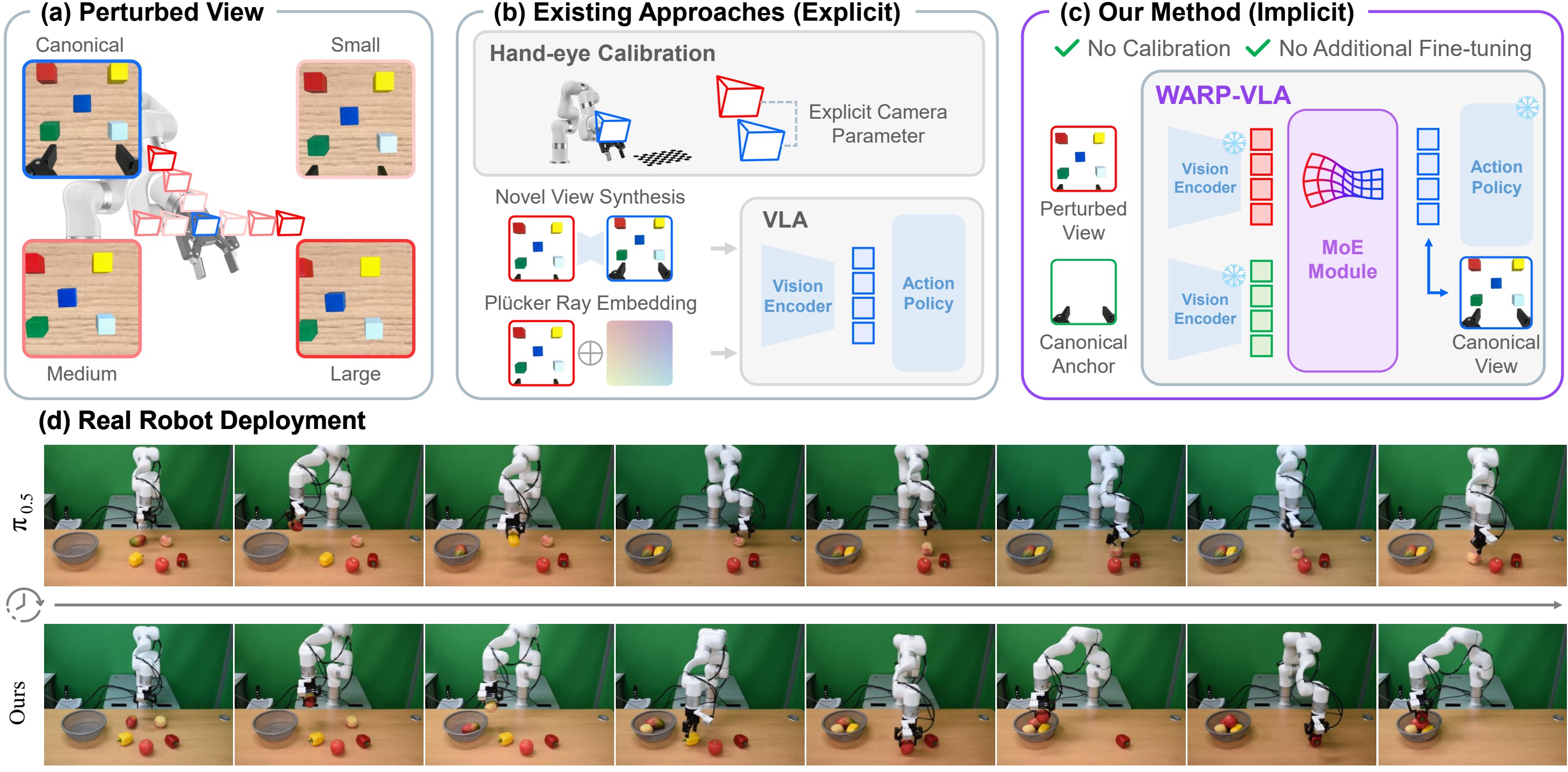
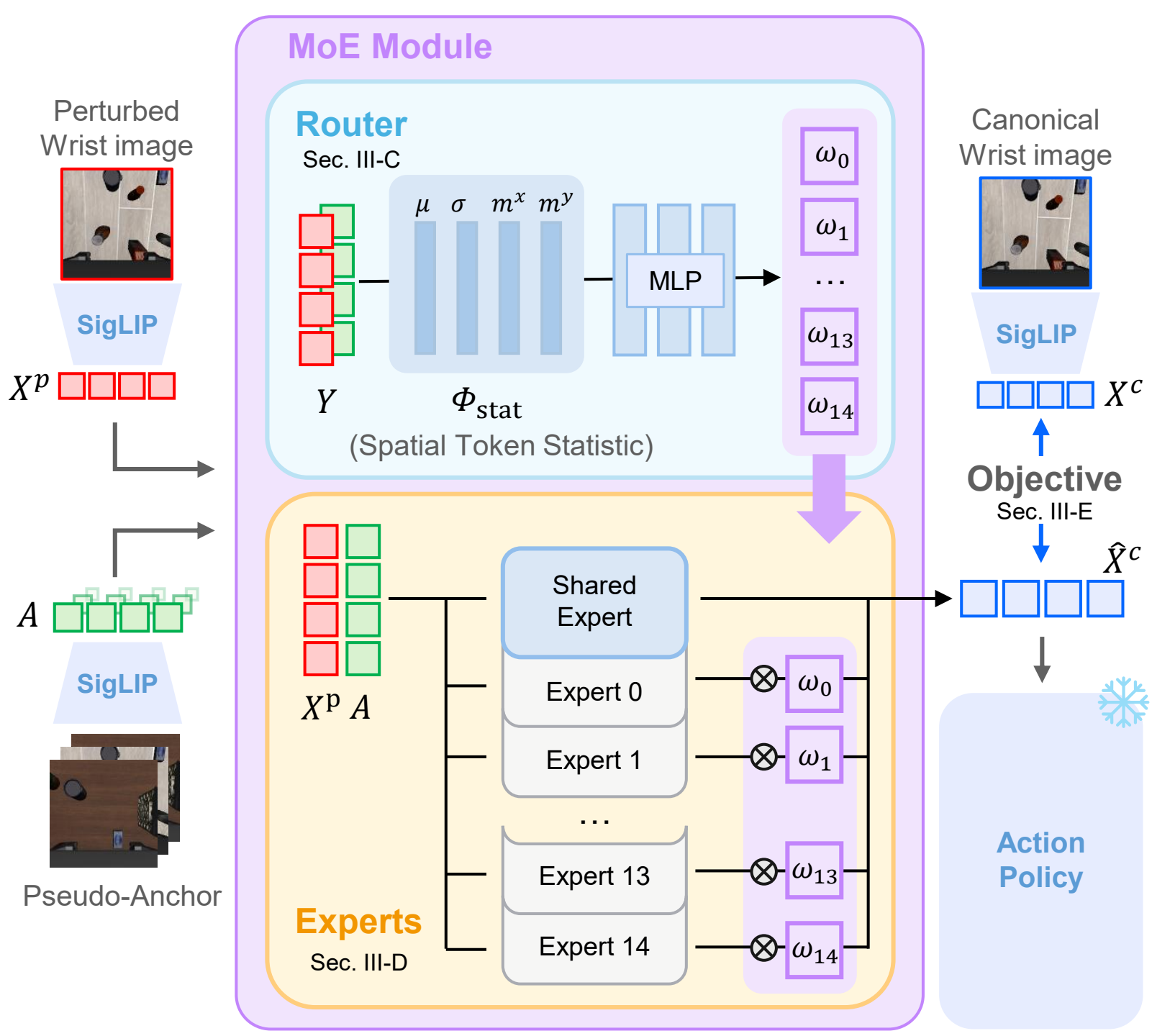
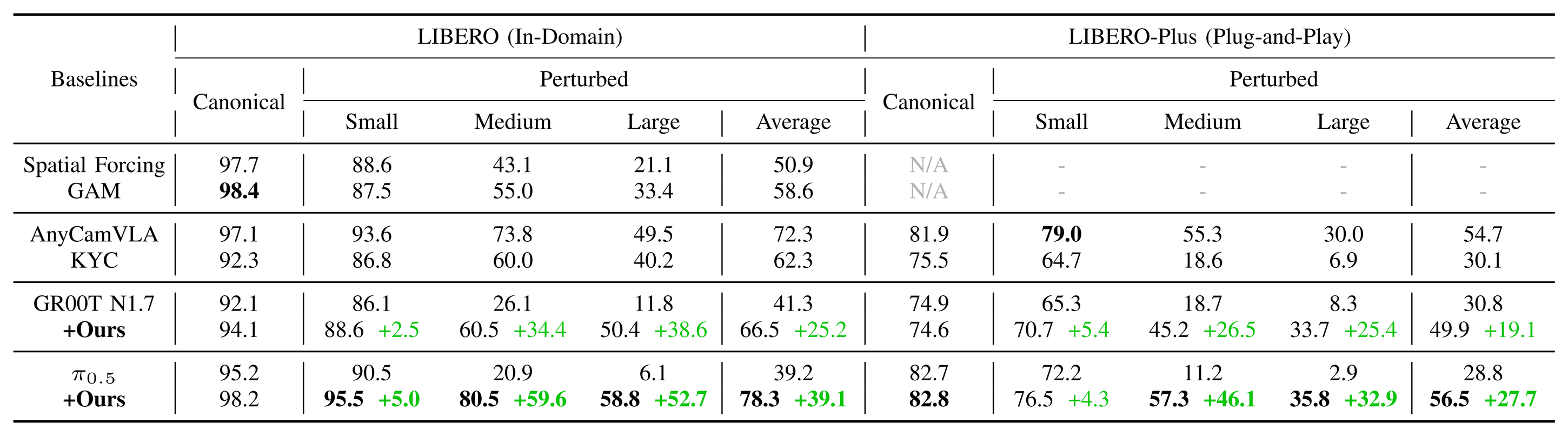
Despite recent advances in Vision-Language-Action models (VLAs) for robotic manipulation, their performance remains sensitive to changes in camera configuration. The problem becomes more evident in cross-setup deployment, as reproducing the exact camera pose used for training is nearly impossible. Unlike fixed external views, wrist views are more challenging because the camera moves with the robot, causing even small mounting variations to alter fine-grained geometric cues. To address this, we propose WARP-VLA, a camera-view-robust VLA for diverse wrist camera configurations. WARP-VLA adopts a Mixture-of-Experts (MoE) architecture where individual experts learn view-specific feature transformations, and a router combines them based on implicit view information. This allows the policy to be deployed without requiring camera extrinsic parameters as additional input. Through experiments on the LIBERO benchmark, WARP-VLA improves the average success rate of π0.5 from 39.2% to 78.3% under wrist-view perturbations. The real-robot experiments further show that the feature-level adaptation learned in simulation successfully transfers to diverse deployment settings.
Video
Method
Results
Simulation Rollouts
Same wrist-camera perturbation for every model. ✓ success · ✗ failure
LIBERO
LIBERO-Plus (large perturbation · background textures)
Real Robot
Put the ball in the cup
More tasks
Same wrist-camera perturbation for every model. ✓ success · ✗ failure
BibTeX
@article{lee2026warpvla,
  title   = {WARP-VLA: Wrist-Camera Adaptation for View-Robust Policy Execution in Vision-Language-Action Models},
  author  = {Lee, Junmyeong and Shin, Dongmin and Park, Min-Gyu and Jeon, Wooseok and Chang, Inho and Jeon, Hae-Gon},
  journal = {arXiv preprint arXiv:2610.11508},
  year    = {2026}
}